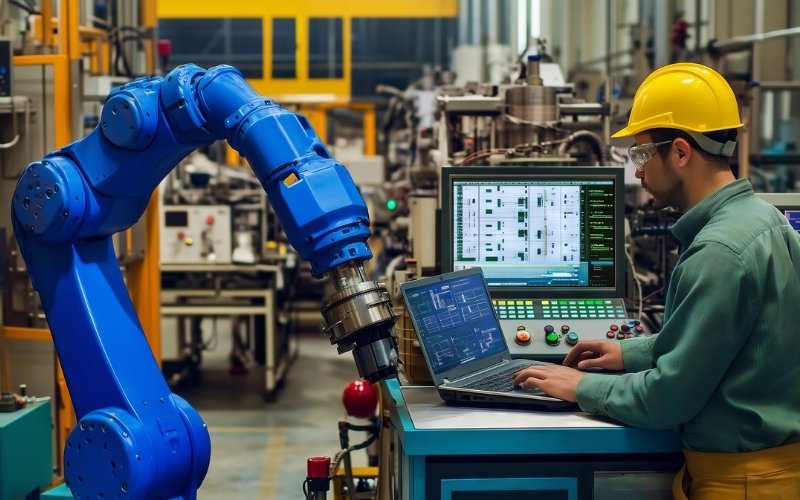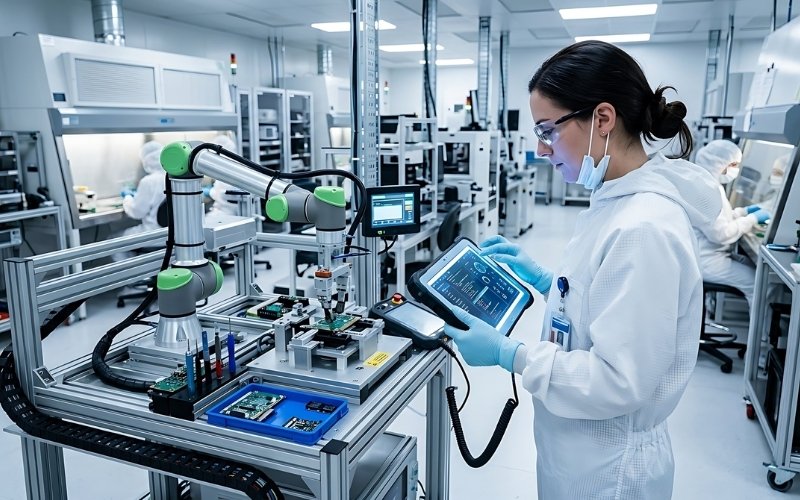

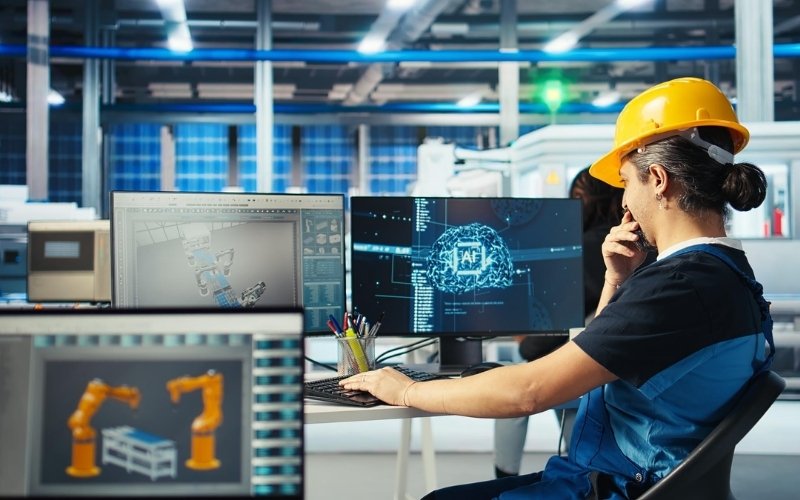
Manufacturing is moving beyond traditional automation toward connected, data-driven operations. Machines, PLCs, SCADA systems, industrial PCs, sensors, and plant-level applications can now work together to create greater visibility across production environments.
Industrial Digitalization brings these technologies together to connect operational data, improve production visibility, support analytics, and create a foundation for connected manufacturing.
For manufacturers in India, digitalization can provide a structured path from conventional automation toward connected factories, real-time production monitoring, industrial analytics, and Industry 4.0.
What Is Industrial Digitalization?
Industrial Digitalization is the process of using digital technologies to connect industrial equipment, automation systems, operational data, and business or plant-level applications.
A simplified architecture can be represented as:
Machines & Sensors → PLC → HMI/SCADA → Industrial Network → Data & Analytics → Plant-Level Insights
Instead of keeping automation systems and operational information isolated, digitalization connects different layers of the industrial environment.
Why Industrial Digitalization Matters in Manufacturing
Traditional automation focuses primarily on controlling machines and processes. Digitalization extends this foundation by making operational information more accessible and usable.
Manufacturers increasingly need:
- Real-time production visibility
- Connected machines and systems
- Centralized operational data
- Production monitoring
- Industrial analytics
- Equipment condition visibility
- IT–OT integration
- Connected factory infrastructure
- Data-driven decision-making
Industrial Digitalization helps bring these requirements together within a connected architecture.
Key Technologies Supporting Industrial Digitalization
Several technologies can contribute to a modern digital manufacturing environment.
PLC Systems
PLCs provide the control layer for machines and industrial processes while generating operational information that can be used by higher-level systems.
HMI & SCADA
HMI and SCADA systems provide visualization and monitoring of machines, processes, alarms, and operational information.
Industrial Ethernet
Industrial networking connects automation devices and systems so that information can move between different layers of the plant.
Industrial PCs
Industrial PCs can provide computing infrastructure for visualization, monitoring, data processing, and other industrial applications.
Industrial Analytics
Analytics can transform collected production information into meaningful operational insights.
Edge Computing
Edge computing allows certain data-processing activities to take place closer to machines and production systems.
IT-OT Integration in Manufacturing
One of the important elements of Industrial Digitalization is connecting Information Technology (IT) and Operational Technology (OT).
IT
IT environments generally deal with business applications, enterprise information, software, and organizational data.
OT
OT environments involve machines, PLCs, SCADA, control systems, industrial networks, and physical production processes.
IT OT Integration creates a connection between these environments.
A simplified structure is:
OT Systems → Industrial Network → Data Layer → IT / Business Systems
This can help organizations connect plant-level information with higher-level applications and decision-making processes.
Connected Factory Solutions
A Connected Factory brings machines, automation systems, production information, and digital technologies into a connected manufacturing environment.
A connected architecture can include:
- PLCs
- HMIs
- SCADA
- Industrial PCs
- Industrial Ethernet
- Sensors
- Production monitoring
- Data analytics
- Edge computing
- Plant-level applications
This allows information from different parts of production to be brought together for improved operational visibility.
Real Time Production Monitoring
Manufacturers need visibility into what is happening across production lines and machines.
Real Time Production Monitoring can provide information about:
- Machine status
- Production status
- Equipment conditions
- Process information
- Production parameters
- Downtime
- Production performance
When connected with automation systems, monitoring solutions can provide a more centralized view of production operations.
OEE Monitoring Solutions
OEE Monitoring Solutions can help manufacturers evaluate production performance using information related to equipment availability, performance, and quality.
OEE monitoring can help organizations identify areas such as:
- Production losses
- Downtime
- Reduced performance
- Quality-related losses
- Equipment utilization
When combined with real-time production data, OEE monitoring can become part of a broader Industrial Digitalization strategy.
Industrial Data Analytics India
Industrial systems generate large amounts of operational information from machines, production lines, and processes.
Industrial Data Analytics India solutions can help organizations organize and analyze this information for operational purposes.
Industrial data can be used to understand:
- Production performance
- Equipment behavior
- Process trends
- Downtime patterns
- Production data
- Operational conditions
The value of analytics depends on the quality, availability, context, and appropriate use of the underlying data.
Industrial Analytics Solutions
Industrial Analytics Solutions can help transform operational data into information that production and engineering teams can use.
For example:
Industrial Equipment → Data Collection → Data Processing → Analytics → Operational Insight
Analytics can support applications such as production monitoring, equipment visibility, performance analysis, and connected manufacturing.
Edge Computing Manufacturing India
As industrial systems become increasingly connected, processing all information centrally may not always be the preferred architecture.
Edge Computing Manufacturing India solutions can enable selected data-processing activities closer to the source of the data.
An edge architecture may look like:
Machine → PLC → Edge Device → Data Processing → Plant / Cloud Applications
Potential applications include:
- Local data processing
- Machine data analysis
- Production monitoring
- Industrial connectivity
- Data filtering
- Edge analytics
The appropriate architecture depends on the application’s data, performance, connectivity, and system requirements.
Siemens Industrial Edge
Siemens Industrial Edge can form part of an industrial digitalization architecture by bringing computing and digital applications closer to industrial operations.
It can be considered within connected manufacturing environments where organizations want to combine automation data with edge-based applications and analytics.
For Siemens-based automation environments, Industrial Edge can complement technologies such as PLCs, SCADA, industrial networking, and plant-level digitalization.
Condition Monitoring
Condition Monitoring uses information from equipment and systems to provide visibility into operating conditions.
Depending on the application, monitoring can involve:
- Equipment parameters
- Operating conditions
- Machine status
- Process information
- Historical trends
- Operational data
When integrated into a broader digitalization architecture, condition monitoring can provide additional visibility into connected industrial assets.
Edge AI Manufacturing
The combination of edge computing and artificial intelligence can enable certain AI applications to operate closer to industrial equipment.
Edge AI Manufacturing can be considered for applications such as:
- Industrial image analysis
- Machine vision
- Equipment monitoring
- Real-time data processing
- AI-assisted operational applications
The specific AI architecture should be selected according to the application’s technical and operational requirements.
AI Machine Vision Industrial Applications
AI Machine Vision Industrial solutions can use cameras, image processing, and AI-based analysis to identify visual information from industrial environments.
Potential applications include:
- Product inspection
- Object detection
- Process observation
- Safety-related visual detection
- Quality inspection
AI machine vision can become part of a broader digital manufacturing architecture when integrated with automation and data systems.
AI PPE Detection
AI PPE Detection is one example of an industrial vision application where computer vision can be used to identify whether specified personal protective equipment is visible in an image or video stream.
Such systems can be integrated into appropriate industrial environments as part of a broader AI and digitalization strategy.
The exact detection capabilities depend on the system design, model, camera setup, environmental conditions, and deployment requirements.
Industry 4.0 Solutions India
Industry 4.0 Solutions India bring together automation, connectivity, data, analytics, and digital technologies to support more connected manufacturing environments.
An Industry 4.0 architecture can include:
Automation → Connectivity → Data → Analytics → Digital Applications
Important technologies can include:
- Industrial Automation
- Industrial Digitalization
- IT–OT Integration
- Industrial Data Analytics
- Edge Computing
- Connected Factory Solutions
- Real-Time Production Monitoring
- Industrial Analytics
Industrial Digitalization for Existing Plants
Digitalization does not necessarily mean replacing an entire existing automation system.
Existing plants can gradually adopt digital technologies by connecting appropriate systems and adding new capabilities.
A modernization approach may include:
Step 1: Assess Existing Automation
Understand PLCs, SCADA, HMI, networks, machines, and available data.
Step 2: Identify Digitalization Opportunities
Determine where production monitoring, data collection, analytics, or connectivity can provide useful operational information.
Step 3: Connect Relevant Systems
Establish appropriate communication between automation systems and digital platforms.
Step 4: Build Data Visibility
Organize and visualize relevant operational information.
Step 5: Add Analytics
Use industrial analytics where there is sufficient quality and context in the available data.
Step 6: Expand Gradually
Extend digitalization to additional machines, lines, or plant areas based on business and operational requirements.
Benefits of Industrial Digitalization
A well-planned digitalization strategy can help manufacturers establish:
Greater Production Visibility
Access operational information across connected machines and production systems.
Connected Operations
Bring different automation and information systems into a connected architecture.
Better Data Accessibility
Make relevant production information more accessible to authorized users and applications.
Data-Driven Decision-Making
Use industrial data and analytics to understand operational performance.
Scalable Digital Architecture
Build digital capabilities progressively according to plant requirements.
Improved Integration
Connect OT systems with appropriate IT and digital applications.
Industrial Digitalization Across Industries
Pharmaceutical Manufacturing
Digitalization can support production monitoring, data visibility, automation, and compliance-oriented manufacturing environments.
Food & Beverage
Connected production systems can support monitoring, traceability, OEE, and production visibility.
Chemical & Process Industries
Industrial digitalization can connect process automation, control systems, plant data, and monitoring applications.
General Manufacturing
Manufacturers can use connected systems for machine monitoring, production visibility, analytics, and smart manufacturing initiatives.
Industrial Machinery & OEMs
OEMs can incorporate connectivity, industrial PCs, PLCs, HMI, SCADA, and digital technologies into machine automation architectures.
How Precise Supports Industrial Digitalization
Precise Industrial Solutions provides automation and digitalization solutions for industrial and regulated environments.
Its broader technology portfolio includes:
- Industrial Automation
- PLC
- HMI
- SCADA
- Industrial PCs
- Industrial Ethernet
- Remote Connectivity
- Plant Digitalization
- Compliance & Validation
- Electrical Control Panels
This allows digitalization initiatives to be considered alongside the underlying automation and industrial infrastructure.
Frequently Asked Questions
What is Industrial Digitalization?
Industrial Digitalization is the use of digital technologies to connect industrial equipment, automation systems, operational data, and digital applications to create more connected manufacturing environments.
What is IT-OT Integration?
IT-OT Integration connects Information Technology systems with Operational Technology systems such as PLCs, SCADA, machines, and industrial control systems.
How does Industrial Digitalization support manufacturing?
It can provide greater production visibility, connect operational systems, organize industrial data, support analytics, and create a foundation for connected manufacturing.
What is a Connected Factory?
A Connected Factory is a manufacturing environment where machines, automation systems, networks, data, and digital applications are connected to enable information exchange and operational visibility.
What is Edge Computing in manufacturing?
Edge computing processes selected data closer to the machines or equipment generating that data rather than relying entirely on a centralized or cloud environment.
What are OEE Monitoring Solutions?
OEE Monitoring Solutions collect and analyze production information related to equipment availability, performance, and quality to provide visibility into manufacturing performance.
What is Siemens Industrial Edge?
Siemens Industrial Edge is a technology platform for deploying digital applications and computing capabilities closer to industrial operations within appropriate automation architectures.
Can existing plants adopt Industrial Digitalization?
Yes. Existing plants can adopt digitalization incrementally by assessing their current automation infrastructure, connecting appropriate systems, and adding monitoring, data, analytics, and digital capabilities according to their requirements.
Build a Connected Digital Manufacturing Environment
Industrial Digitalization is transforming manufacturing by connecting automation, industrial data, analytics, edge computing, and digital applications.
From IT–OT Integration and Connected Factory Solutions to Industrial Data Analytics, OEE Monitoring and Edge Computing, a structured digitalization strategy can help manufacturers build a more connected and data-driven operational environment.
Connect your operations. Unlock industrial data. Build the foundation for smarter manufacturing with Precise Industrial Solutions.